
Cat Carrier Training: When Your Cat Runs From the Door
For cats who avoid the carrier, or step inside and leave as soon as a hand reaches for the door.
· Sources checked for this article.
In this article
Your cat follows a treat into the carrier. You reach for the door, and they are out again before the latch moves. Getting inside was one part of the task; staying comfortable while the door changes is another.
Carrier training gives you a way to practice those parts on ordinary days. It also gives you something specific to discuss with the clinic: which part your cat can manage, and where they become worried.
Make the carrier easy to approach
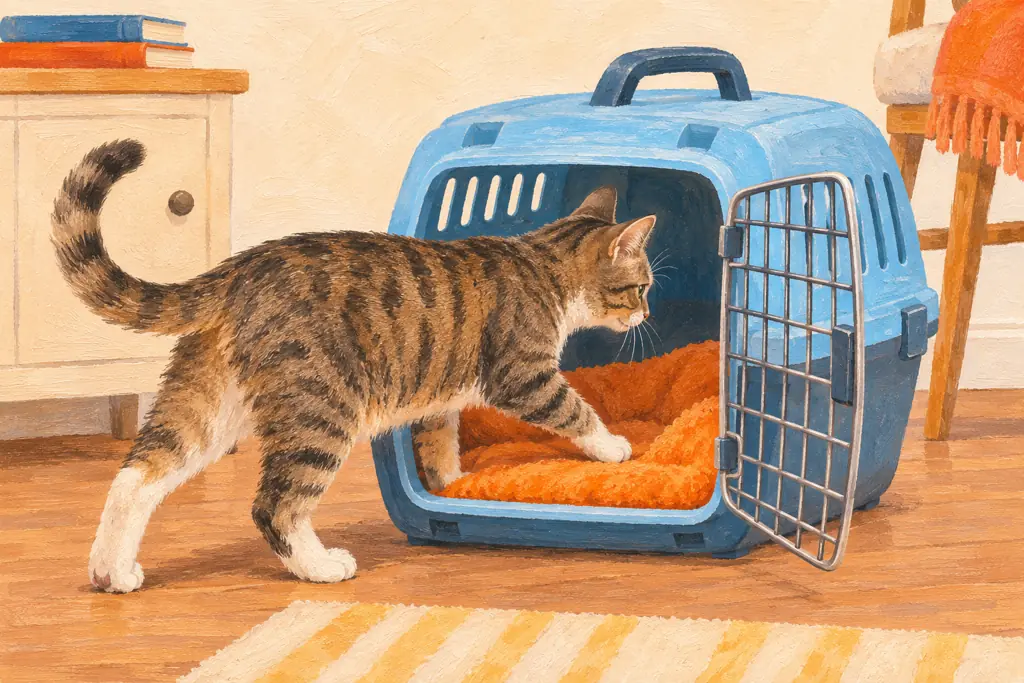
Choose a carrier your cat can stand, turn and lie down in comfortably. Check its fasteners and ventilation. A removable top can make access easier at the clinic. Leave it in a quiet area your cat already uses, with comfortable bedding and its door secured open.
For a cat who keeps their distance, a reward near the carrier may be a useful starting point. If a hard carrier comes apart, using its lower half initially is another option described by Connecticut Humane Society. Add difficulty gradually as your cat becomes comfortable.
Offer rewards your cat enjoys. Keep regular meals available in a comfortable place if food near the carrier makes your cat hesitant; AAHA’s guidance specifically cautions against turning an anxious cat’s meals into a carrier exercise.
My cat goes in, but runs when I close the door
Pause the door-closing attempts and check the smaller steps. Can your cat enter and stay while the door remains still? Can they remain comfortable when you move your hand toward it? Practice the latch without your cat inside so you can operate it smoothly.
Connecticut Humane Society separates voluntary entry from gradually closing and latching the door. Use an easier step when your cat becomes worried. Repeatedly getting them inside and then rushing the latch can leave you practicing the same escape.
| What you see | What to work on |
|---|---|
| Cat stays across the room | Comfort near the carrier, with no attempt to shut the door |
| Cat enters and immediately backs out | Voluntary entry and a little comfortable time inside |
| Cat rests inside until your hand reaches over | A smaller hand or door movement, without adding carrying |
| Cat is comfortable with the door latched | Discuss and practice the next transport steps gradually |
This is a way to organize your observations, not a fixed training schedule. Keep a note of the last comfortable step so the next session has a sensible starting point.
Comfort inside does not always carry over to travel
The lift, walk to the car and car journey add movement and new sounds. Keep the carrier supported and steady. Ask the clinic how to secure your particular carrier for travel and whether a cover would help; ventilation must remain clear.
Keep the carrier closed during the journey. Drooling or vomiting can be signs of travel sickness, which is another reason to talk with the veterinary team rather than assume more carrier practice will solve everything.
What if the appointment is tomorrow?
Call the clinic and describe the difficulty now: hiding when the carrier appears, resisting handling, leaving before the door closes, or becoming distressed during travel. Ask for an immediate plan suited to your cat and carrier. Some cats need veterinary-prescribed support as well as training.
Do not borrow another pet’s medicine or improvise a dose. Do not postpone urgent veterinary attention while working through these steps. You can use the vet-visit worksheet to record what has happened before and the instructions the clinic gives you.
How long does carrier training take?
Expect the pace to vary. Connecticut Humane Society describes a range from days to months; that is context, not a promise. A cat who rests in an open carrier may still need help with its door, being lifted or travelling.
For the next session, write one observation: “settled inside with door open; left when hand moved toward latch.” That gives you a smaller place to begin than “get the cat ready for the vet.” Keep the carrier available between appointments, and plan the return home too if you share the house with another cat.