
Where to Put a Litter Box in a Small Apartment
For a small home where every possible litter-box spot has a drawback.
· Sources checked for this article.
In this article
The bathroom has a washable floor, but someone closes the door. The living-room corner is always open, but it sits beside the television. A cabinet would hide the tray, although getting a scoop inside looks awkward. In a small apartment, choosing a litter-box location usually means working through trade-offs like these.
Start by watching how your cat reaches each spot during an ordinary day. You are looking for an accessible toilet, including when visitors arrive or an appliance starts. A corner that looks private from the sofa can still leave a cat facing a difficult doorway.
Compare the room during its busiest hour
Battersea recommends a quiet, safe location that stays accessible. Use those criteria to compare your actual rooms. The following table is our planning aid, not a ranking of rooms that suits every cat.
| Candidate | What might work | What could rule it out |
|---|---|---|
| Bathroom | Easy-to-clean floor; room to scoop | A door that closes, shower traffic or a noisy washing machine beside the tray |
| Living-room corner | Open route and easy daily checks | Speakers, an exposed window or a narrow gap behind furniture |
| Screened nook | Some visual separation from the room | A screen that traps the cat in a dead end or makes cleaning difficult |
Draw the route before buying furniture
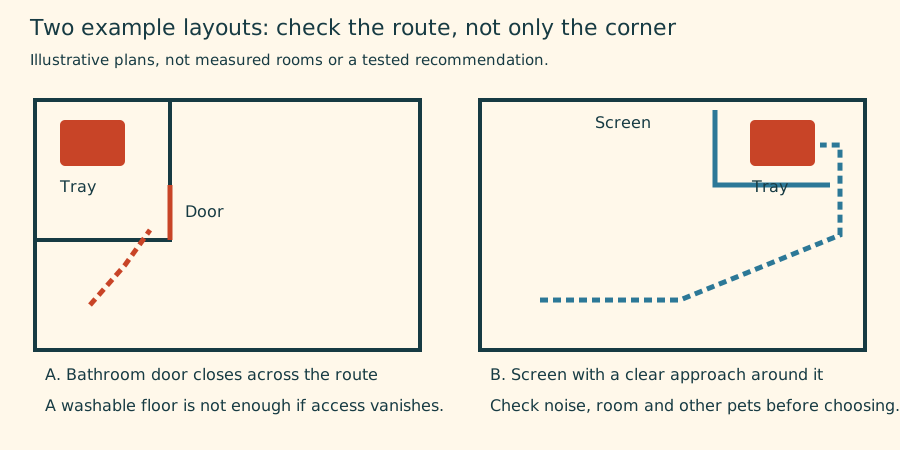
On a scrap of paper, mark the proposed tray, the nearest door and the furniture around it. Add the way you will approach with the scoop. In a multi-cat home, mark where the other cat tends to sit. This small drawing can reveal a problem that a photograph taken from above misses.
Consider two example layouts. In the first, a tray sits behind the bathroom door; the route disappears whenever someone shuts it. In the second, an open corner is partly screened from the sofa, with a clear approach along the wall. The second may be more workable, provided the screen does not restrict movement. These are examples to inspect in your own room, not tested floor plans.
If one cat waits outside the bathroom while another uses it, moving the tray farther into that same room may leave the bottleneck unchanged. Our article on one cat blocking food or litter looks more closely at that problem.
Can the litter box go inside a cabinet?
Check the space available to the cat, not just whether the tray fits through the cabinet door. Can the cat enter and turn comfortably? Can you remove waste without dragging everything out? Does the enclosure concentrate smells or leave one guarded entrance?
A piece of furniture does not have to become the permanent solution simply because it was expensive. Keep a familiar usable option while you find out whether your cat accepts a new arrangement. Avoid changing the location, tray and litter together; that makes an avoidance problem harder to understand.
A location check you can do today
- Walk to the spot with doors in their normal positions.
- Check it while nearby appliances are running.
- Look for another pet's waiting or ambush spot.
- Make sure food and water have their own locations.
- Try the cleaning route yourself before committing to the space.
RSPCA Australia also advises quiet, accessible locations away from food and water. There is no need to invent a universal number of feet for your apartment. Assess the arrangement you can actually maintain.
If your cat starts toileting elsewhere
Keep a note of what changed and check health concerns before treating it as a decorating problem. Repeated attempts with little or no urine need emergency veterinary assessment. For other changes, contact your veterinary team and use our guide to peeing outside the box. A better corner can help access; it cannot diagnose the cause of pain or altered output.